
Nylon Fabric Apparel OEM: From Fabric Engineering to Functional Garment Manufacturing
The Value of Nylon Fabric Lies in How Reliably It Performs in a Garment
In functional apparel development, fabric is more than an outer surface. It affects the wearing experience, garment appearance, pattern performance and production consistency. For brands, sourcing teams and product developers, evaluating nylon fabric requires more than checking whether it looks lightweight or sporty. Moisture management, temperature comfort, stretch recovery, durability, sewing performance and post-finish stability all need to be considered together.
For an apparel OEM manufacturer, the real value is not simply presenting a finished garment. It is the ability to translate fabric characteristics into a practical, verifiable and repeatable manufacturing process. Yarn selection, fabric construction, finishing, pattern engineering, cutting, sewing and final inspection must work together around the intended product application.
1. Controlling Fabric Performance Through Yarn and Construction
The hand feel, surface appearance, drape, stretch and durability of nylon fabric are influenced by yarn specification and fabric construction. Different yarn fineness, luster and elasticity can create very different results in the finished material. During development, yarn selection, fabric density, construction, weight and surface character should be matched to the intended garment rather than optimized in isolation.
For lightweight trousers, outdoor pants and functional casualwear, the fabric must balance low weight with coverage, shape retention and durability. Excessive focus on lightness may create transparency, distortion or sewing challenges, while an overly dense construction may reduce the desired feeling of breathability and comfort. During sampling, an OEM team should therefore review fabric weight, thickness, recovery, drape, shrinkage and sewing response as a complete set of requirements.
Fabric construction also needs to work with key garment areas such as the knees, crotch, pockets and hems. A fabric advantage only becomes a garment advantage when the material, pattern and sewing method are developed together.
2. Moisture Management Requires Finishing and Garment-Level Validation
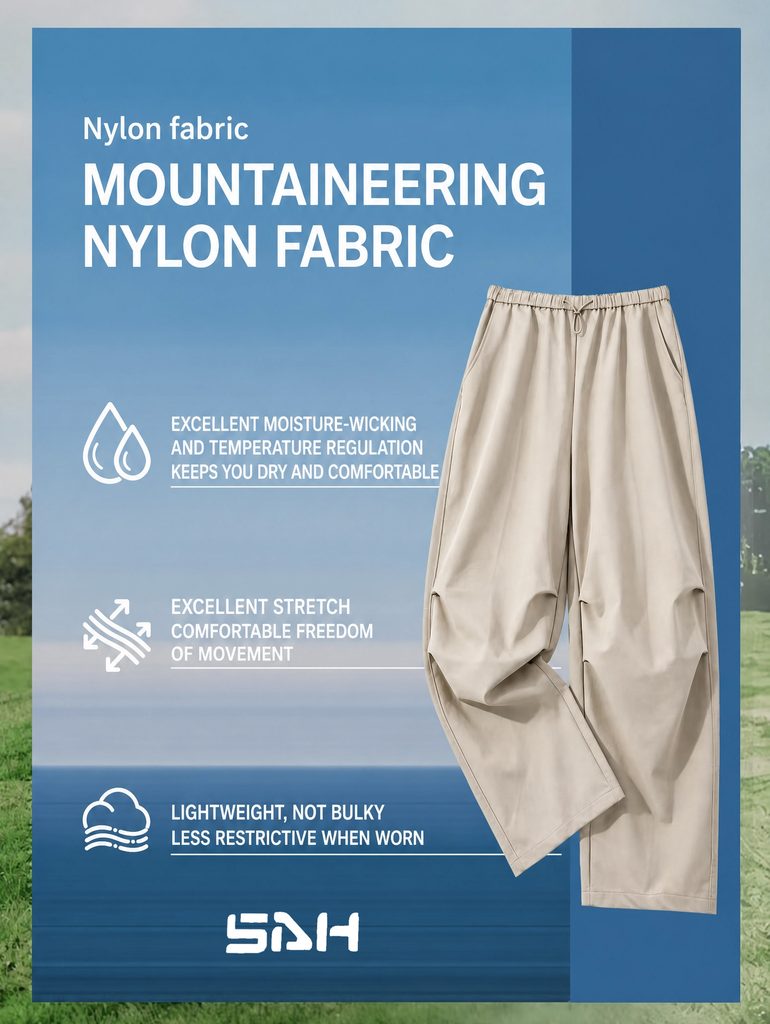
The first performance direction shown in the reference image is moisture management and temperature comfort, supporting a dry and comfortable wearing experience. In an OEM project, this type of performance should not remain only a marketing statement. It needs to be connected to fabric selection, finishing development and garment validation.
Depending on the product positioning, the development team may evaluate suitable moisture-management, hydrophilic or quick-drying finishing options. Each finishing route can influence hand feel, color appearance, wash durability and dimensional stability. The correct solution therefore depends on the fiber composition, fabric construction and intended use of the garment.
Garment construction also affects comfort in warm or active conditions. Panel placement, ventilation zones and targeted construction details can be considered according to the product application. A well-managed OEM development process should move from fabric confirmation to sample-garment validation, post-wash evaluation and pre-production approval before bulk manufacturing begins.
3. Stretch Comfort Depends on Fabric Recovery and Pattern Engineering
The second performance direction is good stretch and freedom of movement. Stretch should not be judged only by how far a fabric can extend. Actual garment comfort depends on horizontal and vertical extensibility, recovery speed, recovery after repeated movement and the amount of ease built into the pattern.
For functional trousers, the knees, seat, crotch and waistband do not require exactly the same amount of movement allowance. Appropriate stretch can help a garment remain clean in appearance while adapting to walking, sitting, squatting and climbing. However, even a highly stretchable fabric may feel restrictive if the pattern does not provide sufficient functional ease.
Stretch nylon also requires process control during cutting and sewing. Lay-up tension, grain direction, seam allowance, stitch length, thread tension and presser-foot pressure can all influence the final result. Without proper control, the fabric may curl at the edge, recover after cutting or produce uneven seams. These risks should be checked through fit samples and pre-production samples before bulk production.
4. Lightweight Construction Is a Systematic Optimization
The third performance direction shown in the image is a lightweight, non-bulky wearing experience. Lightweight apparel is not created simply by reducing fabric weight. It requires a coordinated approach to yarn selection, fabric density, trims, pocket construction, lining, interlinings and overall garment architecture.
A fabric that is too thin may compromise abrasion resistance, tear resistance or shape retention. A fabric that is too heavy may undermine the comfort and mobility expected from a lightweight product. The right target is therefore a balance between weight, performance, appearance and production stability.
At garment level, unnecessary layers can be reduced, pocket constructions can be simplified, and lightweight trims can be selected where appropriate. Light fabrics also demand careful sewing control. Incorrect needle size, stitch length, presser-foot pressure or sewing speed may lead to needle marks, puckering, pressure impressions or distorted seams.
For an OEM customer, lightweight development should not mean making the garment as thin as possible. It should mean achieving the required performance with the lowest practical burden in weight and bulk.
5. Key Bulk Production Controls for Nylon Garments
During bulk manufacturing, nylon fabric can be affected by batch-to-batch color variation, width changes, shrinkage, stretch differences and cutting tension. To improve garment consistency, an OEM project should include fabric approval, shrinkage testing, colorfastness evaluation, dimensional checks and trial production of critical areas before bulk cutting.
Fabric Batch Management
Different fabric lots may vary in color, hand feel, width and stretch. Before production, the team should verify lot information, inspect the material and confirm compatibility between the shell fabric, contrast panels and trims.
Cutting and Lay-Up Control
Stretch or lightweight nylon should be laid with controlled tension. If the fabric is stretched during spreading and then cut, the finished panels may shrink back and create measurement problems. Marker planning should also consider grain direction, surface luster and left-right panel symmetry.
Sewing Parameter Confirmation
Needle size, thread, stitch length, presser-foot pressure and seam construction should be selected according to the fabric weight, stretch and garment structure. Stress points such as waistbands, pockets, knee panels, crotches and hems should be checked for seam strength, smoothness and movement comfort during pre-production approval.
Washing and Final Finishing
Washing, setting and pressing may affect garment measurements, hand feel and surface appearance. The finishing method and temperature should be confirmed before bulk production to reduce the risk of uneven luster, distortion, unwanted impressions or changes in the intended fabric performance.
6. Process Communication Is the Foundation of a Successful OEM Project
Apparel OEM development is not simply about copying a garment from a reference image. It is about converting the customer’s product objective into clear and repeatable production standards. For nylon fabric apparel, the early technical discussion should cover the intended use, target hand feel, performance expectations, fabric weight, color range, pattern requirements, measurement chart, trim specifications and expected order quantity.
When a customer already has a reference fabric or sample garment, the OEM team can analyze fiber content, weight, fabric construction, finishing and sewing details. When the customer is still at the concept stage, the manufacturer can support fabric recommendations, sample development and process evaluation to establish a practical route to bulk production.
A process-led communication model helps reduce unnecessary sampling, lower the risk of late-stage revisions and improve consistency between production batches. For brands and sourcing teams, this type of fabric-to-garment coordination is often a more meaningful measure of OEM capability than a single finished sample.
Turning Nylon Fabric Advantages into Repeatable Manufacturing Capability
Moisture management, stretch comfort and lightweight performance can only be delivered consistently when yarn selection, fabric construction, finishing, pattern engineering, cutting and sewing are developed as one connected process.
The value of an apparel OEM manufacturer lies in connecting these stages: beginning with fabric evaluation, continuing through sample validation and pre-production approval, and ending with a consistent bulk-production solution. For brands and buyers, the key question is not only what a garment looks like, but whether the OEM partner can establish a reliable development system from fabric performance to finished-garment delivery.
No responses yet